The towns this site writes about
Twelve towns in three groups, and a note on why the groups behave differently.
The place writing on this site covers a compact area either side of the lower Connecticut River and the manufacturing towns west and north of it. The grouping below is not administrative. It follows how the towns were built, because that is what their housing has in common.
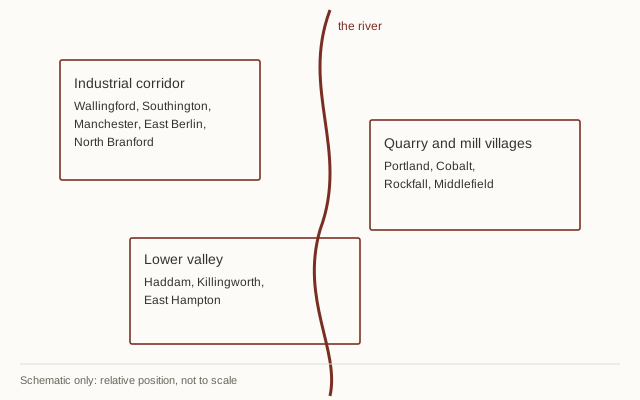
Lower valley
Haddam, Killingworth, East Hampton
Landing settlements, farm parcels and a long stretch of low-density building.
Quarry and mill villages
Portland, Cobalt, Rockfall, Middlefield
Brownstone and mill work, and the compact worker housing that followed it.
Industrial corridor
Wallingford, Southington, Manchester, East Berlin, North Branford
Grid streets around old works, then post-war tract expansion on the farmland behind them.
Why grouping by history explains more than grouping by distance
Two towns ten minutes apart can have almost nothing in common as housing. One grew around a works and has a dense grid of small nineteenth-century houses near the centre; the other never had an industry and consists of farmsteads and a scatter of post-war building on large lots. The first has a supply of small houses that cannot legally be reproduced today; the second has almost none and no way to create them. That difference outlasts any cycle.
Landscape does the same work. Where the river cut terraces, villages sat on the flat ground above the flood and farms took the slopes. Where the stone was worth quarrying, a village of worker housing appeared next to the hole. Where wetland and ledge dominate, the buildable land is fragmentary and expensive to service, and the housing is sparse regardless of demand.
Reading a town by what it is built of
A useful first question about any town here is what share of its houses date from before 1900, from the industrial expansion, from the post-war decades and from the recent period. The mix predicts most of the practical questions that follow: whether properties are on sewer or septic, whether basements are dry, how the houses are heated, how large the lots are, and whether the centre is walkable or merely old.